X-Factor and Racism

Have I told you how much I love Peter David’s X-Factor? I don’t believe I have, given I’ve never reviewed the book on here before. Shame on me.

Seems like the best time to do it is now, given all of the racist hooplah ruining the world as of late.
X-Factor

X-Factor #217
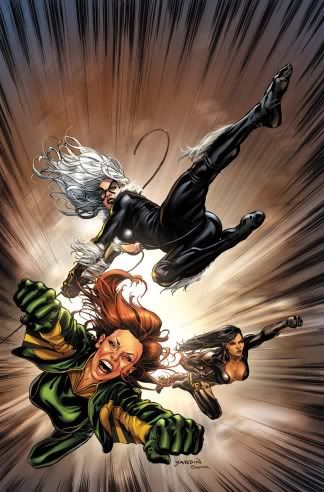
Peter David (writer), Emanuela Lupacchino (pencils), Guillermo Ortego (inks), Matt Milla (colours), Cory Petit (letters), David Yardin and Sonia Oback (cover). $2.99

Hunting for a murdered friend of J. Jonah Jameson, the hired X-Factor team splits up into two groups. Longshot, along with Rictor, Shatterstar and Madrox work to unveil the face of the killer at the scene of the crime, while Monet, Banshee and Strong Guy act as Jameson’s bodyguards.

The story quickly pieces itself together, building up to a tremendous finale. With some brilliant dialogue from David, the reader is left to wonder about relations between Longshot and Shatterstar, while worrying how quickly X-Factor can stop the killer.

What stands out for some great reading is the battle of emotions and religion between Monet and a New York audience about both racism and mutantcy. Jameson gets himself into the brawl and puts the protesters in their place with his quick wit. Crafty words are one of David’s greatest highlights with X-Factor and they can always guaranteed you’ll be glued to the page.

I’ve always been fond of Lupacchino’s work as I feel she can generate any facial expression flawlessly. This holds true in the issue with a great moment with Jameson and his bodyguard after being entranced by Banshee’s speech. She’s just a fantastic, unfortunately over-looked artist. At a monumental, if not one of the most important endings in recent X-Factor stories, Lupacchino beautifully crafts what may be a terrible blow to the X-Factor family.

My little beef, if any at all, comes from Black Cat’s almost irrelevant appearance. Admittedly, I can see her purpose for the next issue, but it was so minuscule that it almost seemed unwarranted. I would have rather preferred more dialogue with Monet and the protesters, or hey! even the mystery behind Longshot and Shatterstar! But I guess beggar’s can’t be choosers.

As probably one of the most powerful X-Factor’s yet – for both message and storyline – David and gang make it clear why X-Factor is the best X-book on the market.

Grade: 8/10

One big difference between San Francisco and New York is that there is prejudice in New York towards Muslims for particular reasons. But the reason why I really wanted to write this piece is because of my Twitter. After the earthquake in Japan, trending topics became “Pearl Harbor” and “Katrina.” By all means, both were tragedies. But the problem I saw was few people stating “The earthquake was karma for Pearl Harbor.” I could not believe it.

So I’ll say it right now: in no way do I agree with intolerance. I hate racism and wish it was abolished. But my point is yet to come.

Now I would like you to see Dean Stell’s review of X-Men Legacy #245. This is entirely relevant because there, Dean touches upon something to which I completely agreed on in the comments below:

One of the problems the franchise has suffered from over the last few decades is that as a society, the United States has become MUCH more multicultural and accepting of differences. . . Now, in 2011, a lot of those nasty old bigots are dead, it seems like half of the high school kids I know either are multi-ethnic or are involved in a multi-ethnic relationship and outside of certain religious groups, homosexuality has become a non-issue. This has made our world a better place, but it has taken that cultural relevance away from the X-Men. Nowadays, I just don’t buy the average Joe in an X-Men comic yelling, “Them muties gotta die!”

I read this and realized that in recent years, Mutants have become greatly accepted in their world. The X-Men are heroes in San Francisco, and there seems to be little, if any bigotry. Dean is right – it just doesn’t work anymore. And when it happens, it’s either too forced or seems entirely unnatural.

Then came X-Factor #217, where it does work.

The funny thing (not really) is that it has the problem has always been there, but the X-comics seemed to forget about it. But suddenly in X-Factor, the X-Men social relevance reinforced itself.

A crowd shouts, “Keep the strangers out!” “We don’t need more Muslim terrorists getting in [New York]!” “Yeah! They’re as bad as mutants!”

Monet appears. “Oh, really? I’m a Muslim and a mutant. Care to take it up with me?”

And so the crowd argues with her, saying wherever her type goes, death with happen.

She replies, “Which ‘type’ is that? Mutants or Muslims?” She continues, “Bad enough to be condemned for what you are. Imagine being hated for what you’re not.”

Monet St. Croix

From there, Jameson jumps in and gives the crowd a quick history lesson on America.

But with Monet. Powerful words.

And the thing is, I don’t remember the last time this was a problem with the X-Men. It has always been vague underlying factor – their move to San Francisco; forced to live on Utopia – for sure the X-Men have had their fair share of prejudice against them. But from recent memory, when was it this bad? When was it a mindset of a society, rather than some bad guy wanting to attack mutants?

Currently in Uncanny X-Men, regular humans are paying to become mutants. In X-Men Legacy and New Mutants, there is prejudice against mutants in a futuristic world – but beyond that, they’re all accepted in San Francisco and asked to help out. Sure, mutants have been attacked by Bastion who hated mutants. But it would be harder to compare it to a social mindset. If anything, it was a comparison to how the military is ran or like religious extremists – if any at all.

What I’m trying to say is that in recent comic books, and most importantly in the X-Men books, I have not seen a blatant call-out against racism. Unless I look for it in the Bastion example above, I cannot just name it. For the X-Men to be the “benchmark” of social commentary in terms of acceptance of other people, I find that it has swayed away from it a lot for years. And even when it seemed “bad” post M-Day (people going up to Xaviers School and trying to get rid of the remaining mutants) it was really all fantasy and seemed forced rather than natural.

Now, it feels real. And when it does feel real again, we know there’s a problem.

Kudos to Peter David.

Wedneday’s Reviews: Retcons and Amazing Fantasies

Hey folks! This week, I’m deciding on doing a review-rant. Yes, they can be one in the same.

As I read this week’s copy of The New Avengers #10, I can’t help but be ridiculously upset with how it turned out.

This is about retcons. Although it is getting ever-so-closer to Marvel’s big Fear Itself event, I can’t help but feel driven to DROP this comic due to the over-ridiculousness of this retcon.

For those who are unfamiliar with what a retcon is, in a nutshell, it stands for “Retroactive Continuity.” What that means is one may go back into time and adjust the events of the past to explain what happens in the future.

For a hypothetical example, we’ll take the X-Men. Most people know that Professor X started the X-Men, consisting of Cyclops, Angel, Jean Grey, Beast and Iceman.

Now imagine a new issue of X-Men, where they explain their history, and suddenly there was a new X-Men who was part of the team – but no one ever talked about him because he worked on another island, behind-the-scenes. Then suddenly in the future, that character appears and everyone’s best friends.

That’s retcon. But it’s a part of comics. How can comics from the 60’s, with arguably simplistic origin plots still be relevant in 2011? Well, retcons help with that – and for the most part, they can be very interesting and neat.

In this recent issue of The New Avengers however, I’m down-right disappointed.

The New Avengers

The New Avengers #10
Brian Michael Bendis (writer), Mike Deodato & Howard Chaykin (pencils), Rain Beredo & Edgar Delgado (colours), Joe Caramagna (letters), Mike Deodato & Rain Beredo (cover). $3.99

The issue flips back and forth through timelines between 1959 and the present. Starting off in ’59, we see Nick Fury and Dum Dum Dugan finding Sabretooth in a bar. After mild negotiations, Fury hires Mr. Creed as an Avenger. Yes, Sabretooth.

Fast-forwarding to 2011, and continuing from the previous issue, the New Avengers attack a H.A.M.M.E.R. installation, headed by Superia. Mockingbird is shot, and for most of the issue, we watch our heroes fight off the endless H.A.M.M.E.R. hordes while calling an ambulance for Mockingbird. Literally, that is all that happens in the present.

In 1959, after retrieving Sabretooth, Dominic Fortune, Namora, Kraven, and Bloodstone are hired – all to be “secret” Avengers. Indeed, a league of villains are now Avengers – all before the “official” Avengers team arrives on the scene in 1963.

Leaving on a strong note, we are brought back to the present where rescue vehicles have arrived for Mockingbird, only for Superia to raze the entire ground beneath them. If it wasn’t for comics, Mockingbird would for sure be dead. But we won’t know until next month! Ahhh!

The comic as a whole does not stand out as anything spectacular. As soon as the first villain was hired, I really could not have been surprised to see anyone else be taken in as the idea of this particular retcon ruined any fun I would’ve had with this comic. I digress.

Deodato is on the ball with this issue, penciling all of the present-day moments, while Howard Chaykin focuses on the 1959 plot. Although both are strong artists, I felt as if Chaykin’s style was a bit light for the seriousness of the book. At one part, Mockingbird is splattered in blood while Spider-Man holds her in his arms. The scene is gritty and dark, moody and in despair. The next scene however, we’re brought to a location where shadows disappear and faces are less-serious than prior. Although I greatly enjoy Chaykin’s art, I feel as if it was wrong for this particular issue. And yet his take on Sabretooth was a bit too childish for me, while his Kraven was spot-on.

And after this issue, I’ve concluded that Deodato draws an excellent Thing.

As for the structure of the story, flipping back and forth between fun and sunny places to a battlefield hurt what seriousness the story had. It felt like flipping channels between an intense episode of Law & Order: SVU and Teletubbies. It was sudden with no transition. It simply didn’t work.

Certain dialogue choices by Bendis also took away from the plot. Nonsensical remarks spewing from Thing early on, then to Ms. Marvel versus Superia mindless jabs, and Spider-Man having fun looking for a cellphone to save a life – all of it damaged the intensities of the moments drawn by Deodato. However, with Chaykin’s work, the dialogue seemed more natural. How is this happening?!

Definitely taking a swan-dive, The New Avengers needs to pick up some smart choices in writing and plotting for it to be saved.

Grade: 5/10

Inner-Fanboy Rant

I love comic books as much as I like turtles. In result, retcons are commonplace and something which I should expect from comics. But not since Secret War, have I felt that Bendis did a retcon so over-the-top that I disagree with it.

Now admittedly, the story is not done yet, so who knows where it will go – but I feel as if it’s not going in the right direction. But when you take serious villains – some which are notorious monsters, and put them on a team, you have a problem. And I’m not talking personality issues, either.

If anything, it seems down-right insulting that the first Avengers – regardless of being “official” ones or “secret” ones are the bad guys. That would be literally like suggesting Professor Xavier had a set of X-Men before the actual X-Men came out – it’s absurd and mind-boggling.

Retcons usually have to explain themselves later on, too. Recent retcon’s like with X-Men’s Deadly Genesis, or Spider-Man’s One Moment In Time, worked for me, because they were explained and honestly, could not be as far-fetched as the “powers that be” were involved with Spider-Man’s, while telepathy and clever storytelling was a part with the X-Men’s. With the New Avengers, we’re fortunate that most of the villains are either dead, or haven’t been used in so-long that the retcon does not have to be adjusted in the future. Sabretooth and Bloodstone are dead, while Kraven is dead-but-alive-now-doing who-knows-what. Dominic Fortune has been MIA for years now, and Namora disappeared with the Agents of Atlas since its cancellation – unless I’m wrong with that.

I guess I’m really just disappointed with how this came about. Admittedly, it has TONS of time to sway another way, but I really feel as if this is just going to hurt my faith in The New Avengers for the next little bit.

Amazing Fantasy

Amazing Sale

As a complete side-note, Amazing Fantasy #15 (1962), the first appearance of Spider-Man, as officially reached the million-dollar club with Action Comics #1 (1938, first Superman) and Detective Comics #27 (1939, first Batman).

Amazing Fantasy #15, CGC 9.6 sold for $1.1 million

“The sale of this legendary comic is second only to the Guinness World record 8.5 VF+ Action Comics #1, which marks Superman’s 1938 debut that was also sold by http://www.ComicConnect.com last year for a whopping $1,500,000.” – Comics Price Guide.com

Amazing, eh?

Keep on Space Truckin’!

Classic Comic Fridays: Amazing Spider-Man Annual #21

The first Friday of each month, I will review a classic comic from my own personal collection.

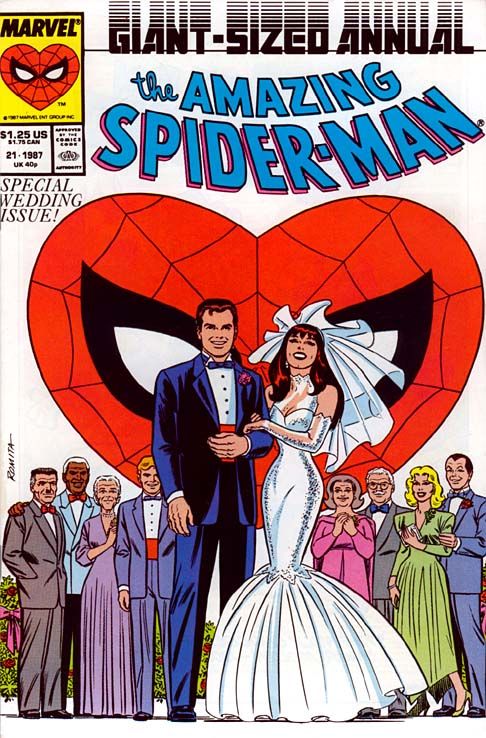
This month, I’ve decided on something I’ve been putting on the back-burner for a while. The Amazing Spider-Man Annual #21 – the wedding of Peter Parker and Mary Jane.

I’ve been wanting to do this since Joe Quesada re-did the wedding issue with his One Moment In Time story arc to compare notes, but really haven’t gotten around to it. It’s also not something I wanted to do – compare two storyboards – but it’s something I wished to revisit. So let’s begin!

Amazing Spider-Man

Amazing Spider-Man Annual #21 (September, 1987)
David Michelinie (writer), Paul Ryan (pencils), Vince Colletta (inks), Rick Parker (letterer), Rob Sharen (colours), John Romita Sr.(cover). $1.25

The story opens with Spider-Man tackling a few foes – from Electro to some common thugs – it’s a breeze for Spider-Man. Heading home, he meets up with Mary Jane where she is busy prepping for their upcoming wedding. Taking limos to do her chores, Peter Parker starts to think how her lifestyle – in comparison to his – seems a bit different.

At work selling photos of Spider-Man beating on Electro, Robbie Robertson sends Peter into the lunchroom for a wedding surprise party. There he receives a cheque from the Daily Bugle to help out with his wedding expenses. As Parker leaves, he runs into Betty Brant just to say hi. Parker then thinks about how he used to like Brant and how his life could’ve been different with her.

Afterwards, Parker goes to Aunt May’s for dinner, awaiting Mary Jane and her Aunt Anna to arrive. Aunt May was looking through old photos earlier and had them out. Peter decides to look through them too while May baked a pie. Peter finds an old photo of Gwen Stacy and tells himself that he was planning on marrying her first.

Mary Jane and Aunt Anna arrive and the four have dinner. After dinner, Peter and Mary Jane announce that they are getting married to May and Anna. (I’m just as surprised as you that they waited days before the wedding to say anything).

As they leave, MJ gets picked up by a friend named Bruce – a man trying to win over MJ’s heart before the wedding – and even offers her two tickets to Paris. Meanwhile, Paker goes to ask Flash Thompson to be his best man.

As the story progresses, MJ goes out and parties with friends while Peter remains home – thinking about how his will be. He slips into a dream where Spider-Man marries Mary Jane. Uncle Ben is there to support Spider-Man, while heroes and villains fill the pews of the church. Suddenly, Gwen Stacy arrives to give Spider-Man a goodbye kiss, and all of the villains defeat the heroes in the crowd then go after Mary Jane!

Peter awakens from his dream to realize that by being Spider-Man, Mary Jane will have dangers to face.

Spider-Man Annual

Inching closer to the wedding date, Peter has his bachelor party with Flash and Harry Osborn at a bar, and the three discuss relationships and as long as Peter loves Mary Jane, everything will be fine. Mary Jane celebrates her bachelorette party with friends, while Bruce appears and yet again and tries to win over MJ’s heart.

Then comes the day of the wedding. Everyone is gathered at the church, worried about how late both Mary Jane and Peter are. Fortunately, both show up around the same time – and terribly late. They have the wedding on time, and MJ surprises Peter with two tickets to Paris for their honeymoon.

By the end of the story, they head back to their small apartment and Peter wonders what they are “doing in a dump like this.”

MJ simply replies, “Living happily ever after!”

And with the end of the story, we have Peter Parker and Mary Jane married up until the events of Civil War. A twenty-year marriage ain’t bad nowadays, right?

. . .

Well the issue itself was presented very well. A definite look into the insight of both Peter and Mary Jane makes the story that much more intriguing as near the end, you can’t really tell where the story will go.

On the down side of things, that’s also the problem: there is too much negativity coming from Peter about the wedding. With Mary Jane gone all of the time and living a lavish lifestyle – not to mention he seemed as if he was going to end the wedding at a dinner in earlier in the book – it’s more surprising that they did get married. Admittedly, if this was a standalone book, this story simply could not work properly unless Peter lived the rest of his life as a lie. Fortunately enough, that is not the case here.

As for the other exciting parts to the book, Jameson’s hilarity throughout the wedding party at the Daily Bugle gave me some laughs. Robbie’s kindness always shines through, and the action scenes at the beginning were just enough to keep the reader interested in the love story which fills the rest of the book.

Art by Paul Ryan gives great depth in his work as particular scenes from Spider-Man on rooftops, to a wide assortment of Marvel characters, to a crazy bachelorette party, can all look and feel different from one another.

But to grade it as a standalone issue, the book doesn’t really work. But since that clearly is not the case, bravo for an intriguing plot!

Grade: 6/10