Classic Comic Fridays: X-Men #95

It has been about four months since I’ve last done a Classic Comic feature. For the new folks here, Classic Comic Friday’s feature a comic from my personal collection which I look back upon and review. Then, if we’re lucky, I can compare it to newer comics similar to it so we can see how things have changed.

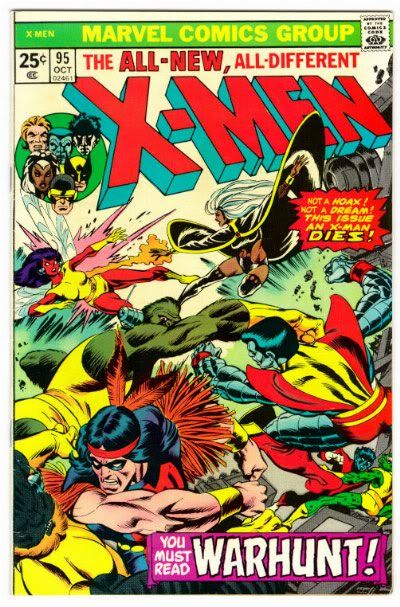
This past August, I was fortunate enough to find a decent-quality copy of X-Men #95: The death of Thunderbird. He was arguably the first X-Men to be killed (because people debate Changeling), and set-off a idea of the “unknown” with these X-Men comics. Another notable mention is that X-Men #95 features Chris Claremont’s second story with the X-Men.

So here we go:
X-Men 95

X-Men #95 (October, 1975)
Chris Claremont (writer), Len Wein (plotter), Dave Cockrum (pencils, cover), Sam Grainger (inker), Petra Goldberg (colours), Karen Mantlo (letterer) Cockrum, Gil Kane & Dan Crespi (cover). $0.25

If you were unfamiliar with the X-Men prior to this issue, Claremont and Wein set up this story so you can fully grasp each character within the first few pages. You find out who is the strongest, which heroes can fly, who the X-Men’s field leader is, plus who has the smartest mouth and who has the biggest ego to them. All within the first few pages. Within those pages, would you believe we also get a recap to who all the villain is – Count Nefaria – AND his masterplan! They certainly do not make stories like they used to.

So now that everyone and everything is established at the beginning, the rest of the story is a playground of fun ideas to entice the reader to keep reading. Nightcrawler teleports in the enemy base to let the X-Men in, followed by a battle between the the villains evil creations: The Ani-Men and X-Men. Just when the X-Men have seemingly won, Count Nefaria escapes in a jet plane. Fortunately, X-Man Thunderbird follows suite and jumps on the plane. As Nefaria tries to escape, Thunderbird uses his brute force and beats the plane down to stop Nefaria at the price of Thunderbird’s own life.

As shocking as it comes to a comic reader that a hero had just died, it was done so artistically well, thanks to the legendary Dave Cockrum. Well-known for his clean pencils and well-plotted out panels, Cockrum owns this book. When the X-Men are on a mountain, their hair is blowing. When problems appear, the faces clearly represent what the characters are saying or feeling. The action sequences are never jumbled and without dialogue, we can tell what is happening in the story. It is very rare to see comics these days like that. But like I said, Cockrum owns it.

Thunderbird's Death

In fact, the whole artistic team really controls this story. While the exposition sets up the characters, the true feeling of this story comes from the art. With a very James Bond-like tone, it’s as if the reader can feel themselves in the trees on a mountain or smell the machinery inside the hidden base. Both Grainger and Goldberg accentuate Cockrum’s pencils with a tremendous dramatic effect. Nothing is overdone on the inks and the fluidity of colour is spot-on. Vibrant sheens across each page really gives this book a light-hearted tone – setting the reader up for the unexpected.

The most exciting part of this book is definitely the unexpected death of Thunderbird. The build up, while readers have seen it in hundreds of comics throughout the years up to this point in 1975 – the death was sudden and done tastefully. The X-Men do not take the death lightly. However, because of the character development and the “team” feel the book gives, readers are forced to read on to the next issue to see how the team deals with the death.

That’s right. There’s no twist ending to make readers want to jump back to the book like a season finale of a TV show. Claremont and Wein compel readers to come back because throughout the book readers are forced to care for the characters. And that’s a more powerful reason to continue reading a book than any cliffhanger could bring.

Grade: 8/10

Looking back on this book, it’s amazing to also consider that Thunderbird is one of the few Marvel characters whom have stayed dead. Aside from some flashbacks or the more-recent Chaos War – Thunderbird, John Proudstar – has stayed dead. It’s interesting to see why that has been the case. Three issues in, of course he would not have a lot of reader fanbase – but it still remains.

To top it all off, there was no cliffhanger of a villain suddenly appearing on the last page. Nor was there a jaw-dropping moment for readers to say, “Wow! I need to go back and read this book!” The readership is solely gained because of how the writers make us feel for these characters. Name three comics nowadays that end that way. It’s pretty hard to come up with a list.

And don’t forget to check out UncannyDerek on Facebook and Twitter!

So until next time, keep on Space Truckin’!

Classic Comic Friday: The Infinity Gauntlet

The first Friday of each month, I will review a classic comic from my own personal collection. Due to Canada Day falling on a Friday and my work schedule being hectic, pardon the week lateness of this review.

My last Classic Comic Friday was the graphic novel, X-Men: God Loves, Man Kills. I had a lot of fun reviewing such a great book, that I really wanted to do something else that I enjoyed reading. But I also wanted that something else to be a major storyline. The only logical conclusion in my mind was the brilliantly written story, The Infinity Gauntlet by writer Jim Starlin, and artists George Pérez and Ron Lim in 1991.

Admittedly, as a child I overlooked this six-issue mini series due to the fact that I was still a kid focusing only on X-Men. Looking back on it now, I wouldn’t have had any idea who or what Thanos or Adam Warlock were. In fact, I can guarantee you, the immensity of showing the Celestials, the Watcher, Eternity, Eon, etc, would not had even impacted me the way it did later in my life.

Didn’t this mini series just kick your butt though?! Nothing could have prepared me for the immensity of this story. This was the first time I, and presumably you, feared for the Marvel Universe. I mean, what could stop Thanos?!

The Infinity Gauntlet

The Infinity Gauntlet #1-6 (July – December, 1991)
Jim Starlin (writer), George Pérez & Ron Lim (pencils, covers), Josef Rubinstein, Tom Christopher & Bruce Solotoff (inks), Max Scheele, Ian Laughlin & Evelyn Stein (colours), Jack Morelli (letterer). $2.50 each

After gaining the six Soul Gems in The Thanos Quest mini series, finally Thanos places them in the Gauntlet to control the universe. And quite literally, he does control the universe. With the Gauntlet, Thanos first tries to impress the entity of Death – the being responsible for allowing Thanos to gain the Soul Gems. However, Death refutes him leaving Thanos to wonder what the price is of becoming a god. With the devil Mephisto at Thanos’ side, Mephisto convinces Thanos to prove himself worthy to Death by using his power for evil. (As if he wasn’t going to do that already.)

From there, with the snap of his fingers, Thanos wipes out half of the universe’s population. On Earth, the Avengers and S.H.I.E.L.D. try to figure out what has caused such a catastrophic disappearance. Glimpses of the Skrull worlds and Asgard show readers that this is not only an Earth event. Not until the Silver Surfer asks for aid by Dr. Strange does everyone understand the gravity of what is about to occur.

Meanwhile, still unable to gain the respect and love from mistress Death, Thanos wipes out a series of planets – sending shock waves to Earth, destroying countries, flooding continents, and knocking Earth off of its orbit from the sun. Earth begins its plunge into a new ice age. It also destroys the Rainbow Bridge, stranding Odin and other gods gathered there from fighting Thanos.

Revitalizing himself from the Soul Gem, Adam Warlock finds Dr. Strange and summons Earth’s strongest and remaining heroes to give Thanos the fight of their lives – and what a blast that is! Not only does it feature Earth’s mightiest heroes getting the beat down by Thanos, but it also features some jaw-dropping moments. Wolverine’s defeat, Cyclops’, Nova’s, and Thor’s death, Iron Man’s beheading – what a terrifying experience for readers.

The Infinity Gauntlet Thanos

After their defeat, the universes mightiest entities take on Thanos, including Love, Hate, Eon, Galactus and Chronos. After their monumental defeat, Thanos takes on Eternity itself. Eternity’s defeat and Thanos’ assimilation as the ultimate cosmic entity only becomes his downfall. Leaving his physical body, Thanos then becomes the embodiment of the entire universe. Unfortunately for Thanos, it becomes his ultimate downfall.

With a thrilling conclusion which threw readers through the ringer of emotions and excitement, The Infinity Gauntlet not only proved to be a worth company-wide crossover, but it literally goes back to the age-old adage, “With great power comes great responsibility.” But that’s not all.

Jim Starlin did not just write this story just to get a message across. He did not write it about “whomever wields this glove.” We’ve seen that before. It is about something so much more that most writers should look at this series as a benchmark. It set up something incredibly fearful in the Marvel Universe. It created the ultimate weapon that absolutely nothing can defeat. To top it all of, it got into the hands of comic books greatest nihilist.

However, it’s still more than just that.

What Starlin made was an incredible, adventurous story. It disrupted the status quo, built great suspense and a climax not even recent story arcs could hold a candle to. Within six comics, The Infinity Gauntlet did more than what most novels could accomplish. The only kicker is that The Infinity Gauntlet is one of those stories that goes under the radar due because it deals with space.

If only more people actually read what happened in Marvel space rather than what just happens on Earth. But I digress.

To be also considered is the fantastic work both Pérez and Lim put into this story. The incredible depth and detail put into the six issues outshines many artists today. My favourite page in the entire series is Thanos’ triumph over Eternity (shown below) as it represents the absolute vastness of the Gauntlet’s power. Although a simple drawing, the concept is immaculate and is skewed within the entire series. The art is nothing-less than magnificent. The versatility of these artists to create practically every Marvel character shows immaculate artistry.

Although the ending itself arguably made the rest of the Marvel Universe “forget” what happened (yeah, there’s always a catch), The Infinity Gauntlet shows us what it’s like to be a god for six issues. I’m afraid that I loved every minute of it.

Grade: 9.5/10

And don’t forget to check out UncannyDerek on Facebook and Twitter!

So until next time, keep on Space Truckin’!

Next month, I’ll be reverting back to single issues for Classic Comic Friday. Until next time, keep on Space Truckin’!
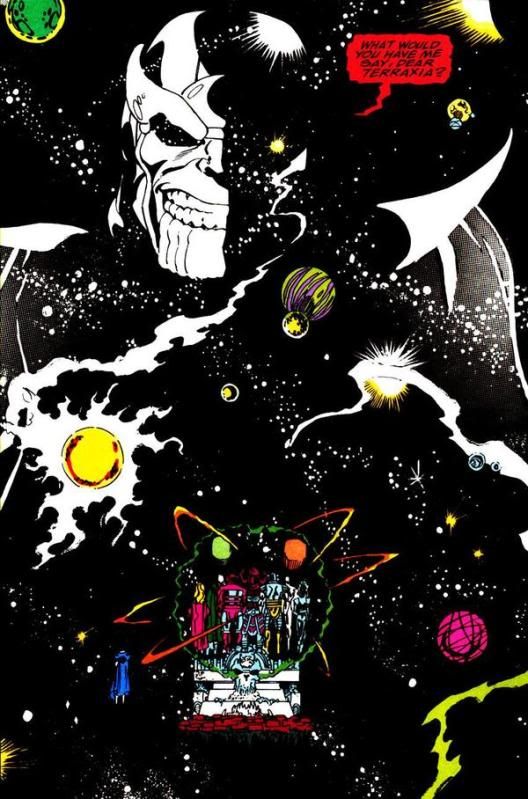
The Infinity Gauntlet Thanos Eternity

Classic Comic Fridays: X-Men – God Loves, Man Kills

The first Friday of each month, I will review a classic comic from my own personal collection.

God Loves Man Kills

I’ve been doing something a bit different with these past few CCF reviews. To keep that going, and to celebrate its release on trade paperback earlier last month, comes Marvel Graphic Novel #5: X-Men – God Loves, Man Kills. I really wanted to speak about it because of it’s overall message.

The story is a turning point in the world of the X-Men. It’s probably one of the most in-your-face stories without trying to hide behind some super villain like Magneto, or huge robots like the Sentinels. This is a story which is very plausible. The results are anything less than astounding.

X-Men God Loves Man Kills

Marvel Graphic Novel #5: X-Men – God Loves, Man Kills (December, 1982)
Chris Claremont (writer), Brent Anderson (pencils, inks, cover), Steve Oliff (colours), Tom Orzechowski (letterer). $5.95

I’m sure you’ve heard of William Stryker. You remember the main villain in the movie X2: X-Men United – the one guilty for giving Wolverine his adamantium skeleton? The one guilty for the Weapon X project? Well this is where Stryker first appeared. But he was nothing of what he was in the movie.

Here, in God Loves, Man Kills (GLMK), William Stryker is a reverend, and we see early in the story that he hates mutants and wishes them all to be cleansed from the earth. In fact, he has a team of religious fanatics called the Purifiers (which you may of heard in X-stories already) who do Stryker’s mutant assassination for him. All of this is done in the name of god. Stryker believes mutants are indeed the “homo superior”, but are not “homo sapien.” Thus, they are products of the devil and must be destroyed.

Stryker’s seems nothing like how he’s portrayed in the second X-Men movie, is he? Neither is the story.

This story is blunt with its readers by contrasting humans and mutants with racial subjection. Within the story’s first few pages, a black family is killed in cold blood – not because of colour – but because the parents bore a son who was a mutant. Then the mutant son and human daughter are executed in the first two pages, then strung up on a swing set for the rest of the world to see. A sign posted on the boy reads “Muties.”

Cut to Kitty Pryde fighting a boy at Stevie Hunters dance studio. She’s fighting because the boy’s family supports Stryker’s endeavors. The boy is unaware of Kitty’s powers, so Stevie jumps in to stop the fight and tells Kitty to back down before she uses them on the boy. Despite knowing that Kitty’s a mutant, Stevie talks to Kitty to calm her down:

God Loves Man Kills

These blatant comparisons to real-life issues are what the basis of the X-Men grew to be. Lately, there have not been many comparisons between racism and mutants, but it is stories like in GLMK which bring us a wake up call by a slap to the face.

GLMK is not a story about hate upon religion. It is definitely not a spite against god, either. It is the idea of hate reaching out and becoming ever-engrossing by shielding itself behind an ideal to be justified. GLMK successfully shows us this with its story.

Stryker becomes so powerful with his rhetoric that he gets to speak at a stadium to preach his word on behalf of god. There, he faces a final showdown with the X-Men with quite a surprise twist.

That twist, too, is a perfect example of how society operates. Without spoiling it, the end recedes what Claremont built up in the entire story. In a way, GLMK becomes a story of Good versus Evil versus Good. It implies the analogy of grass being green on the other side and shows that there is still a continuous loop to what is defined as both good and evil.

I cannot talk about the moral of the story without mention of Brent Anderson’s moody pages. As a graphic novel, these stories get a lot more attention to than regular comic books. It shows.

Immense time and effort was placed into crafting a grim story amongst a fearful backdrop of hate and despair. Anderson successfully hits every mood with every turn of the page. Even when the climactic ending comes into play, the positive feeling the reader should get with the falling action is narrowed by Anderson’s art. As both the drawer and inker, Anderson has no boundaries to how he makes wonderful sketches seem downright terrifying.

Steve Oliff’s colours hit the mark. Rarely are pages splashed with colours to give any sort of hope to the mutants. Even on a sunny day, Oliff works the panels to still suggest danger afoot. Even with the image above between Stevie and Kitty, Oliff’s use with white, red and black tones really separate the different feels in each panel.

GLMK is a phenomenal story which I would suggest is deeply prevalent, even today. With the recent reactions and discussions from the public on the death of Osama bin Laden, it is somewhat frightening that thirty years later, GLMK could still a possible and harsh reality.

A story that never stops teaching is a story always worth reading.

Grade: 8/10

As a side note: I went to the midnight viewing of Thor. I would definitely say it was the most accurate portrayal of a Marvel character, and I was quite happy with the film. It is certainly worth seeing a few times. Tons of love and screen time was given to Sif and the Warrior’s Three – which is something I was not expecting. There’s also tons of little tidbits added into the film for Marvel fans to enjoy – so stay sharp!

Don’t forget to stay after the credits.

Keep on Space Truckin’!

Classic Comic Special: Comics, Covers, and Barcodes!

I usually use my Classic Comics feature to review a comic book. However, I’m going to do something different and talk comic book barcodes. What are comic book barcodes for? Why do some have pictures of Spider-Man’s head instead of the barcode? How and why did they affect comic book covers of Marvel and DC from the late 70s and early 80s? Let’s delve in.

Barcode Strikeouts

What are those? Let’s take a look!

For comics coming out at a time when technology didn’t move so fast, there had to be assurances for companies like Marvel and DC. But more on that soon.

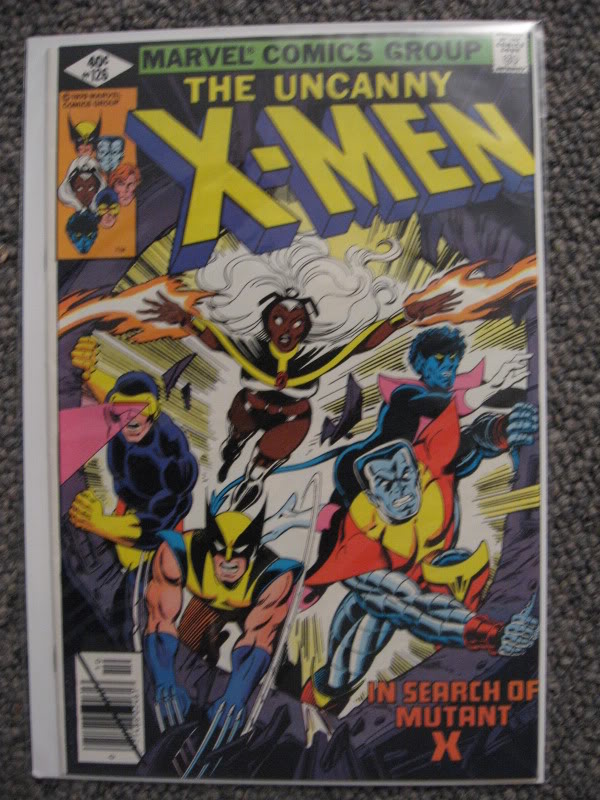
Here’s my copy of X-Men #126 from October of 1979. By all means, I invite you to click on the image to see it larger. Please pardon the quality of my old camera.

XMen

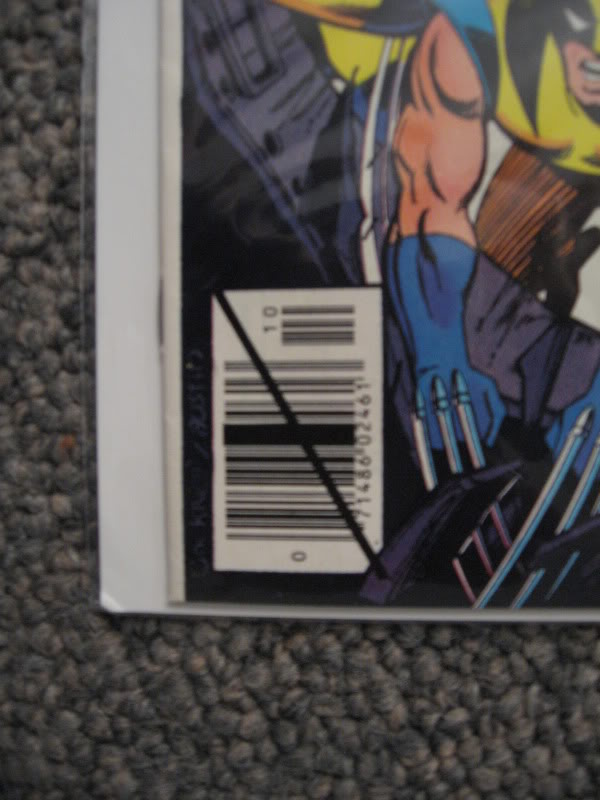
Let’s take a closer look at the bottom-left corner of the comic.

BarcodeStrike

I remember when I first started collecting, I had no idea why someone would put black strikes through the barcodes. Eventually, it dawned on me how the strikes only seemed to have affected a particular era of comics. In fact, the strikes they weren’t drawn on but actually printed over top of the barcode. I wanted to know what it meant (and I’m sure you do too)!

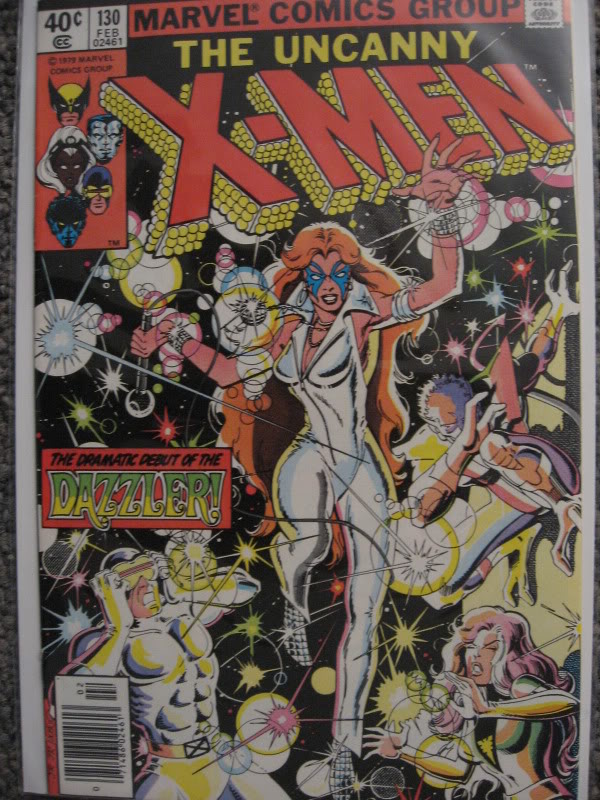
Three of the following X-Men comics I have featured strikes up until X-Men #130, from February of 1980.

XMen

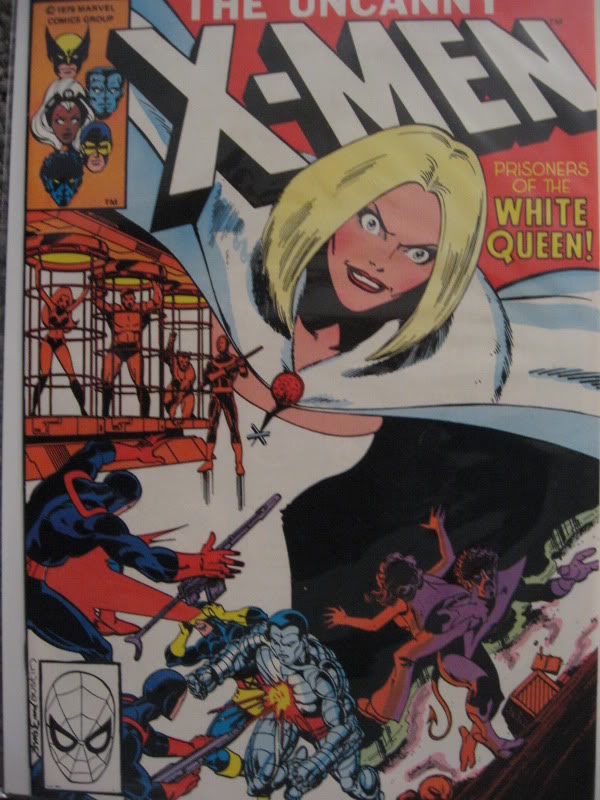
Then issue #131 – a month later – it didn’t have a barcode at all!

XMen

Instead of a barcode, I see. . . a picture of Spider-Man? But I’ve seen issues of X-Men #131 with a barcode! What happened?!

Direct Edition vs. Newsstand Edition

A crossed out barcode means the comic book is a Direct Edition. So what’s that?

In a nutshell, there are two “types” of editions: Direct and Newsstand. A Direct Edition is sent to the comic book store and sold there. A Newsstand Edition is something which a newsstand would carry (seems obvious, right)? However, this was not just exclusive to newsstands, as malls, convenience stores, and drugstores could also receive Newsstand Editions.

A Direct Edition comic is crossed out due to a variety of things. One is because it tracks sales for the publisher, while another reason is to stop the store owner from returning the comics they did not sell. A crossed out barcode means the barcode could not be scanned into inventory for the publisher to accept as a return.

Obviously, that means the Newsstand Editions could be returned back to the publisher.

Arguably, Direct Edition comics are more sought-after because they would have been treated more carefully. They were less likely to have been placed in spinner racks, for example, and more likely to have been bagged and boarded. Direct Editions were also bought by the dealer at a lower price presenting another reason why dealers were unable to return them.

That being said, do you remember The Amazing Spider-Man #36? It was called the “Black Issue” as it was a tribute to the events of 9/11. I personally own a copy of that comic. Comic book dealers would have received one without a barcode on the cover at all. I bought mine at a local variety store which did have a barcode on the cover.

Believe it or not, if you have a good quality copy of that book WITH a barcode, it’s actually WORTH MORE because it is considered rare to find good-quality copies of Newsstand Edition comics. That “rule” really only applies to key issues of books, for the most part. Ultimately, it depends on the buyer.

Interestingly enough, Direct Edition dealers/comic book store owners were usually unable to scan the comics they brought in as most Direct Edition carriers did not have scanners for barcodes at the time. The technology simply wasn’t there yet or was too expensive for the comic shop owner to take on!

Due to the lack of technology from many of the comic dealers, Marvel replaced the Direct Edition barcodes with things like the Spider-Man head, or DC with Batman. On top of that, it was a way to promote extra little tidbits. Who doesn’t remember “50 Years of Captain America”, or “Spider-Man’s 35th Anniversary”? It was printed on every comic where the barcode should be. It made more sense to put those on Direct Edition books anyway as the readers would be more familiar with what’s happening in their comic book universe rather than a random person purchasing a book at a corner store.

Nowadays, since everyone is mostly on par with technology, barcodes have returned and comics just state whether or not they are Direct Editions. For example, here is a picture of Uncanny X-Force #1 from October of 2010. What does it say right next to the barcode?

Until next time folks, keep on Space Truckin’! If you’d like, you can also follow me on Twitter and Instagram!
UPDATE May 18th, 2020 – What if there’s LITERALLY NOTHING to go on?

This barcode blog has certainly been one of the most-viewed pages on my site. I’ve had many people message me both on here or through private messages to help find information on their books and clarify the understanding of barcodes. However, a recent inquiry piqued my interest and prompted me to update this post.

I completely forgot about the comic books that do NOT have barcodes. And no, I don’t mean the Spider-Man head barcodes.

I had Benn from the UK message me. He sent me a couple of photos of his book and its lack of a barcode – and lack of a back page, of all things!

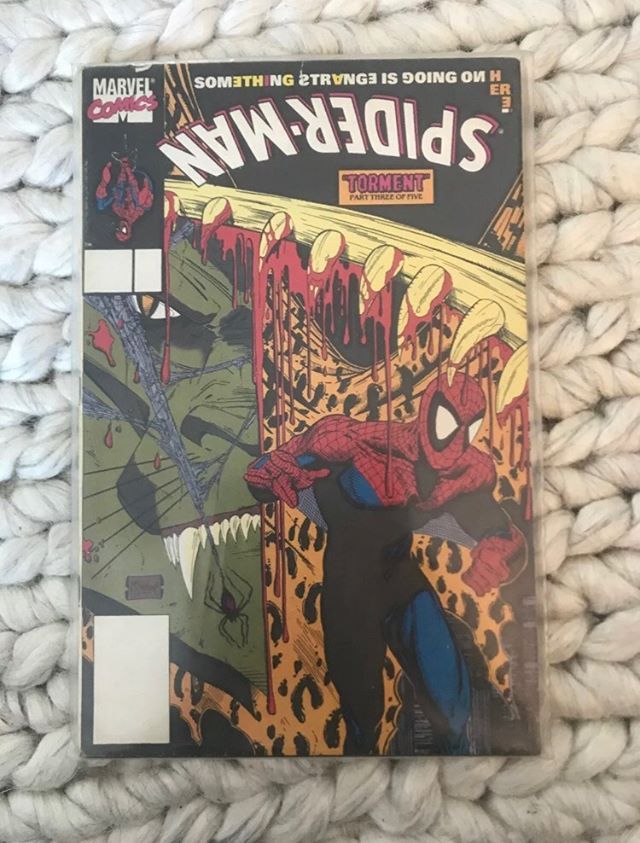
His issue was Spider-Man #3 – from Todd McFarlane’s run. This issue was “Torment Part 3” from 1990.

Looking at the cover, there’s red flags abound! There’s no barcode, no pricing, and no issue number! The information on the book’s cover are entirely stripped away. To make matters even stranger, the background colours are also different.

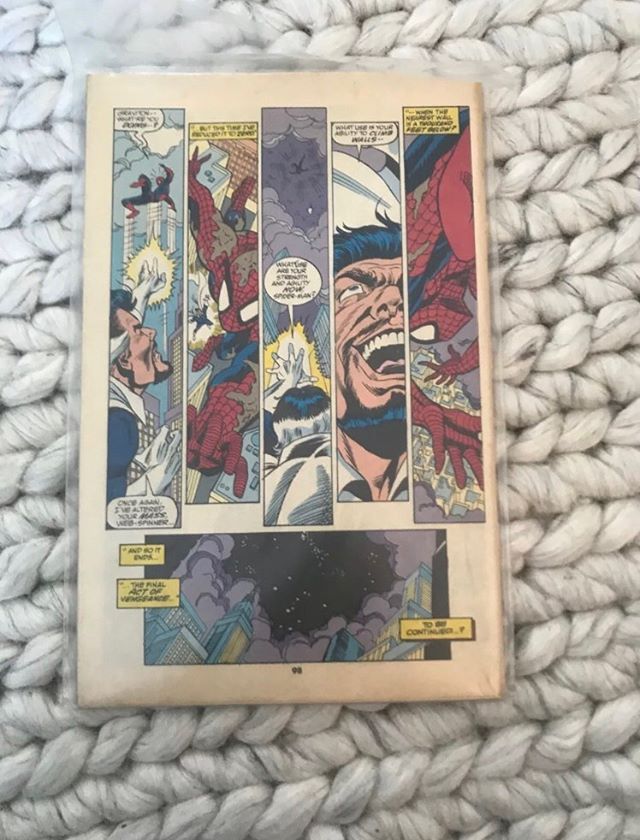
Benn also sent me a photo of the back of the book:

There’s no tearing or obvious removal of a back cover. The staples are intact. If you look closer, the cover actually wraps around to the back page. The book simply didn’t come with a back cover!

What gives? Benn’s book instantly reminded me of a Spider-Man giveaway series we saw here in Canada back in the early nineties.

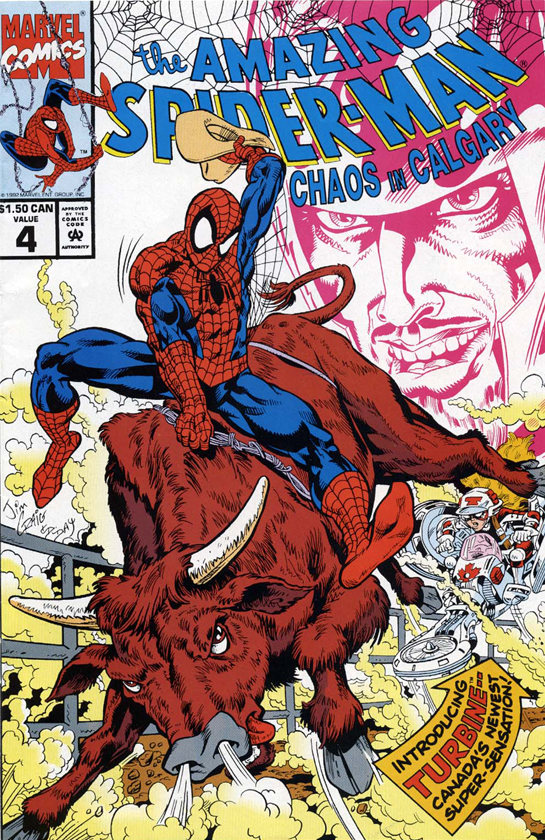
I personally had Spider-Man’s “Chaos in Calgary” and “Hard Ball” issues. They were part of a five-issue Spider-Man promo/giveaway from Marvel which was targeted to Canadians to have them read more Spidey books. Unlike Benn’s book, these books had both their prices and issue number on them. However, there was no barcode at all, let alone a spot for one on the cover.

Based on my prior experience on a few books without barcodes, and because Benn’s book featured a colour variant, I have to assume it was a reprint of some sort. Due to a lack of barcode, it must not have been scanned into stores – similar to the Direct Edition Spidey-head barcodes. I also could not find any information in the Overstreet Guide or Comics Price Guide, as if Benn’s book wasn’t actual “comic books” per se. Without a barcode, if Benn’s book was free or offered as a promotion like “Chaos in Calgary,” it would not get scanned into inventory at all – tracking wasn’t important because the book would have had no inherent value at the time.

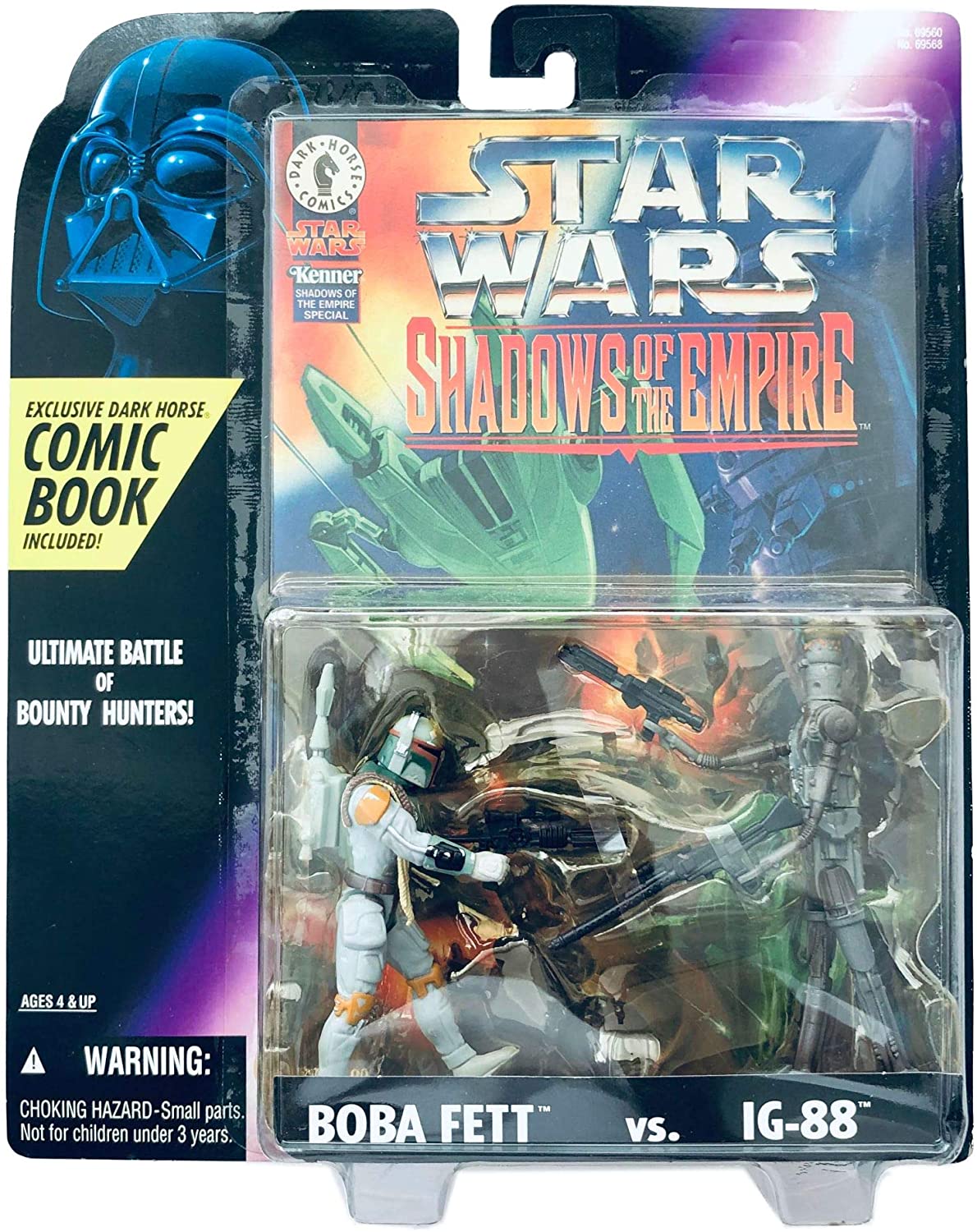
What Benn’s book reminds me of are the Comic Packs of the 90s. I remember one in particular which clearly had no barcode on the cover:

The Shadows of the Empire comic from Dark Horse all but confirms to me Benn’s book would have been part of a toy pack. Like Benn’s book, there’s no issue number, barcode, or price. Unlike Benn’s book however, the Shadows of the Empire book wasn’t necessarily a reprint because it hadn’t been published before. Benn’s book is a reprint for sure, but considering it to be from a toy pack, it may explain the lack of a back cover as the back would have been more expensive to print. The book would not have had a barcode because the barcode was on the packaging of the toy, not the book. It may also explain why I could not find any information of the “book” in either the Overstreet Guide or Comics Price Guide – because this may – and I’m using this term very loosely here – be labelled as a “toy” not a comic.

Personally, I’m not sure what it could be labelled as. Due to COVID-19, I certainly cannot go to any comic book or toy conventions to ask the dealers there.

Benn’s book leaves a lot of unanswered questions with it: was the book actually part of a toy or just a giveaway? Benn’s from the UK and certainly distribution and rules for it would have been different than in the Americas – does that play a factor to why there’s no numbering on it? Would you classify the book as a “toy?” If so, would “Chaos in Calgary” get a pass? Does packaging define the product? I’d argue Benn’s book is a comic book. Looking into the Overstreet guide, it doesn’t recognize Dark Horse’s Shadows of the Empire toy pack books. However, the Comics Price Guide does.

Unfortunately I am unable to offer Benn a true answer to his book. It certainly is a unique piece though! If you know of any action figures that may have sold with Benn’s Torment #3, please let me know!

Happy collecting, everyone!