Comic Animation and Boobs: Taking Women Back 50 Years

Women in Comics

As a kid in the ’90s, there was one thing on my mind – action! I loved watching the ’90s Batman, X-Men, and Spider-Man cartoons. I gathered myself around the television daily to witness the sheer brilliance these cartoons possessed.

On this site, you may have read my views on how Body Images are seen in comics, or how poorly Women are Portrayed in comics. It wasn’t until I sat down and watched DC/Warner Bros. newest animated film, Superman/Batman Apocalypse, did my mind erupt with frustration.

I am well-aware the movie is based off of a comic book run by Jeph Loeb & Michael Turner. I am also quite aware that the animation in the film is very similar to that in the comic. What I am shocked over is how blatantly awful the film was for younger viewers. From the camera angles chosen, to how much physics breasts were given, it was completely over-the-top.

Taking the Cake

Now to be fair, looking back at the X-Men cartoon in the ’90s, Rogue wasn’t really a conservative girl, nor was Wolverine a regular looking guy – he was shirtless in plenty of episodes. However subtle those instances may have been in the X-Men cartoon, Superman/Batman Apocalypse take the cake.

I will also mention that Superman/Batman Apocalypse is rated PG-13. However, if you have a kid in a video store and you see a Superman cartoon movie for them to watch, the last thing you check for is the rating. It’s a cartoon movie based on a beloved world icon – what could go wrong?

Yet, if this is only for teenagers to watch, what kind of message is it giving them?
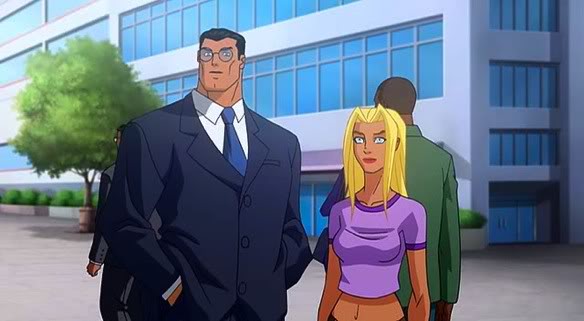
Supergirl Middrift
The first thing I’d do when I crash land on a different planet is show as much skin as possible.

The basis of the movie is that Supergirl, or Kara, came to Earth and is trying to fit in with society and find herself a home. For the uninitiated, Supergirl is Superman’s cousin. Without really going into the story, there’s a montage where Supergirl takes women back to the Stone Age.

“What is like to be a girl in the city?” Kara asks Superman.

Cue montage of Supergirl getting her nails done, shopping for clothes, and being the stereotypical “rich girl” while good ‘ol handsome-boy Clark Kent pays the bills. Ah, being a girl is sweet, isn’t it? That is, as long as you have a strong, rich man to pay for everything.

Supergirl Changing
“Don’t you like my new bathing suit, cousin?”

Ah, Kara Zor-El. Welcome to Earth. Learn our archaic ways.

Is Supergirl Dressed
Isn’t she like, 14?

For those familiar with the story, you will also know that Kara gets kidnapped by Darkseid to become the leader of his army. Superman and Batman get Wonder Woman and Big Barda to help out with the rescue. Of course, when they ask Barda to help, she just took a shower. How inconvenient for the viewers.

Bare Barda
“Thanks for stopping by. Don’t mind me. I won’t get changed.”

And once the team travels to Apocalypse to save Kara, Wonder Woman and Barda get caught up fighting the Furies. Thanks to some particular camera angles, we can see why the Furies want to fight them. They’re jealous of Diana’s “attributes.”
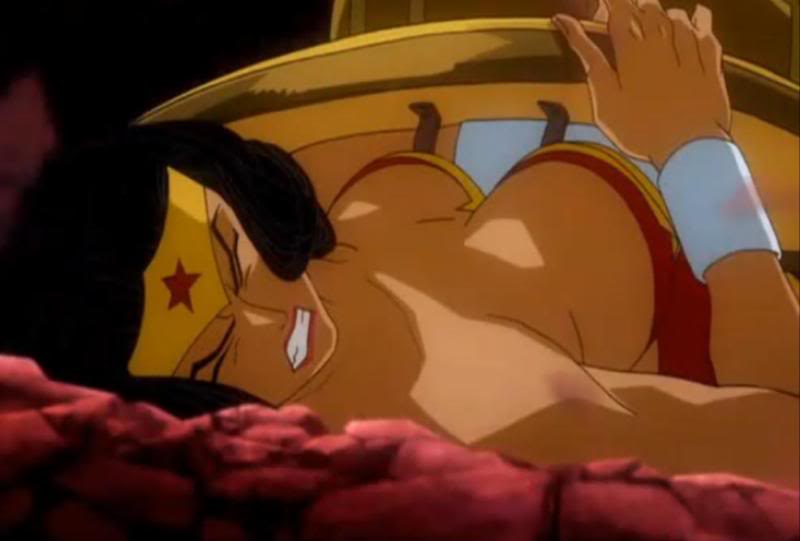
Diana Double Ds
Tons of thought goes into these camera angles.

Luckily, Superman knows where Darkseid has hid Kara, so he’s goes in to save the day – only to find out that Kara is now mind controlled by Darkseid. AND! She’s changed wardrobes too, ’cause, y’know. Less clothing makes you more evil.

A New Supergirl Costume
Is this legal to watch?

So you can probably see some of my conundrums with this film. Of course, there’s tons more to show. The movie is riddled hyper-sexualized women.

I am aware that this isn’t the first movie or comic book to do so. If you looked at my previous entries I linked at the beginning of this blog, you’ll notice that I’m ragging on Marvel very hard for what they’ve done before.

And while, sure, the movie art matches how the comic was drawn, by no means did it need to be done this way. By no means do the particular camera angles chosen NEED to be there.

Taking Women Back 50 Years

I’ve shown you the physical proof of what the movie provided. What stuck to me is the lasting effect it would leave upon others.

Arguably, comics are directed towards young boys. Obviously, showing women the way they are in this movie would definitely drive those sales. What is wrong is the movie takes one limp forward and multiple steps backwards.

For sure, Kara learns a lesson in this film about finding herself. But at what cost?

If I were a young boy watching this movie, I’d be excited for the action, and even more blown away by how attractive all of the women are. Kara is just being a young girl, barely old enough to be allowed to watch the movie she is starring in. Men on the other hand are the strong and mighty. Although women can fight, they’re not nearly as cool as Superman or Batman. All they like to do is shop or get kidnapped and wait for men to rescue them. Your typical hero story.

Wonder Woman may be considered an exception as she “owns” an Amazon Army. However, the army loses a battle and Superman is left to save the day.

Now if I were a young girl watching this movie, I would notice that shopping is a lot of fun. I would love to look as good as Kara in those clothes and it would be even better if I didn’t have to pay! Wonder Woman has her own place, but cannot defend it unless Superman is there. Then the Furies fight Barda and Wonder Woman, I would be bombarded by breasts, hips and lack of clothing. By the end of the film, I would be happy that Supergirl found her way, but still be left to feel empty. There would be no reason for me to re-watch that movie and the images shown would be imprinted in my psyche forever.

In fact, the movie insults the strength of the already-strong female characters as men save the day.

Wait. What did she just say?

I know that comics can never really change. They will mostly be marketed towards boys, and that’s just how it is. But what can change is a mindset on how women should be portrayed.

Comic panels do not need to have massive breasts on every female character, nor does a movie need to shift camera angles to show particular features to its characters.

If you’re looking to impress boys, you do not have to do it by taking women back years of progress. But by doing so, you’re preventing a female audience from even caring, while still being damaging in the process.

It’s not a double-edged sword unless you make it to be one.

Keep on Space Truckin’.

Writing, Drawing, Inking & Exploding

And not in that order.

Personally, I have been unbelievably busy being creative. (Hooray for alliteration!) In fact, I’ve completely put off many other things in order to muse myself. It’s been pretty ridiculous, actually.

I’m holding off on reviews again this week – despite so many exciting comics coming out – only because I’d rather focus my energy elsewhere. My mind has been going at a mile a minute, you’d think I was on uppers. (I’m not, don’t worry.)

However, I feel an apology coming on because I’ve sort of let this site slip in the past few weeks. I know what it’s like to check back and not see an update when expecting one. I read WebComics regularly, and on some I see reasons why they’re on hiatus. Alas, I am not going on hiatus, but am just going to post whenever I can instead.

This means “Wednesday’s Reviews” may appear on Friday with only one review, then reappear on Tuesday with two more reviews. This way, I can spread my time out more effectively rather than explode over crunch time.

The funny thing is that I was not planning on writing that last paragraph at all, but it just sort of made sense to me.

One thing I will mention about this weeks comics is that Mike Carey made a killer turnaround with the Age of X story he’s working on. If you haven’t touched upon any of them yet, for the love of all that is holy, do it! It’s been quite the ride so far.

Until next time, keep on Space Truckin’!

Comic Books Are Not Cool

“Why don’t you read a real book?”

How many have heard that phrase or variations of it? How many have received even the slightest bit of condescending remarks from friends or family just because you read or collect comics?

I mean, comics clearly are not part of the worlds forté unless it’s in movie form for the most part. For example, this Hallowe’en I dressed up as the Red Skull. I thought it was awesome, because, well I am awesome. I approached a guy at a bar dressed up as Captain America and started talking to him about his costume. After a few minutes, it came down to me blatantly asking him if he knew who I was (in costume form, of course). When I told him, he started at me blankly with a “who?” D’oh! The Captain America movie isn’t out until later this year!

Another friend of mine that night went as the Black Cat. She approached a couple dressed up as Spider-Man and Spider-Girl. Talking to them both, she discovered they had no idea who the Black Cat was. D’oh! Felicia Hardy wasn’t in the movies, so how could they know who she was?

But wait a tick! Why is it okay that they dress up as Superheroes and not know anything about them? Surely the one guy didn’t dress up as Captain America because he saw the not-yet-released movie. And I doubt he was inspired to dress up as Cap after seeing the 1990 movie.

Personal History

I don’t know how many times I’ve been snickered at, or received odd looks from people after I told them I read comic books. Going to university for an English and Professional Writing degree should mean that I read real books, not funny books after-all. Well, I mean, that’s probably what I should be stereotyped as. But I will mention (and plug) that my friend Kyle over at Panel Flow was the only other person I knew in my course who read comics.

However, even predating university, when in elementary school, I grew up around comics and Star Wars. Of course, my peers all thought I was a bit of a nerd, given those were the only things I read on a regular basis.

Yet, when I look back on this past decade, liking superheroes seems to be the cool thing to do – regardless if you actually know anything about them. I even knew people who pretended to be really interested in comic books. They would have a favourite character, favourite book series, favourite super power, and so-on. However, when you would want to talk to the people about your apparent common interests, they would be put on the spot and try to avoid or change the topic. Why would they even bother?

Don’t Believe the Movie Hype!

What I am really just building up to is that comic books seem to be accepted now, unless you read them. It sounds rather ridiculous, but if you really think hard – comic sales for a movie like Iron Man, sell around 50-60k a month. However, the box-office for an individual Iron Man movie easily excels $500 million. If they aren’t buying the comic books, then what drives them to the movies? How do they know about Iron Man? Comic sales have not drastically increased, despite a second Iron Man movie making over $600 million – so what gives?

How are comic movies accepted – but comic books are not? Is there not an irony to this?

Stan’s Soapbox

This whole idea of mine spawned from reading a except of Stan’s Soapbox in Marvel comics during December of 1968:

“The next time anyone puts you down for reading a comic mag, try hitting him with this little soliloquy which I’ve used on various radio and TV guest appearances in the past few months:

Comic books are a medium of communication – just as television and motion pictures are. All three employ words and pictures, and all must be judged on their individual merits. A story is a story, whether presented between two covers or on a screen. If the words have dramatic impact, if the pictures are visually appealing, if the theme is emotionally relevant, then certainly it is worthy of a reader’s attention. However, if the quality is lacking, then it rates little consideration. Isn’t this equally true of a TV program, a Broadway show, a motion picture, or any other form of entertainment? All we at Marvel ask is that our product be judged on the basis of quality – a quality which we sincerely believe is equal to that found in any other comparable media.

Marvel Comics today are produced by the finest creative talent available. Read them first. . . and then decide.

Excelsior!
Smiley”

Although Stan speaks about Marvel, it can easily be argued for any other company. But why are comic books still not considered cool? Why don’t more people read them, and why is there still a stigma attached to them?

I know adults who have seen movies Batman or Iron Man, yet joke to an individual about reading comic books. Are they not the same thing? Do comics in popular culture stop with movies and become stigmatized when they go into paper form?

I don’t know!

It’s a lot to take in. I would LOVE to hear what you guys have to say about this.

Until then, keep on Space Truckin’!

What’s a CGC?

Hey, folks! First I’d like to say I’ll be a few days late on my Wednesday reviews because I’ll be off to Toronto for the evening. I apologize for any inconvenience this may or may not cause.

Secondly, as promised, here is my explanation of the CGC!

I was fortunate enough to be able to deal with the CGC when I met Stan Lee in Toronto last August for Hobbystar’s FanExpo event. In a nutshell, it’s Canada’s version of the San Diego ComicCon (or SDCC).

I was one of the first people in line to have something signed by Stan Lee – that being my copy of X-Men #15 from December of 1965. It was a dream come true – to meet my childhood idol AND to have him sign something he actually created.

While in line, CGC had a sign there stating that they would be taking submissions for their signature series. Someone from CGC (actually it was someone who was licensed by the CGC, Desert Wind Comics) was present to witness the signing.

Here’s where you ask, “Wait. How can you prove the book is signed? Why does it matter?” Enter the CGC.

What is the CGC?

The Certified Guaranty Company, also known as the CGC, is a company dedicated to the grading, acting, consistency and commitment to comic books and their collectors. They are, by all means, the largest unofficial-official “authority” in comic book collecting. But more on that later.

What does the CGC do?

The CGC will grade your comic book with a scale from .5 to 10.0. To be fair, it also goes through three stages of grading. The Restoration Detection Expert, the Pre-Grader, and the Grading Finalizer. Hefty, eh? Each person does their own job and makes notes about the grading. Once all three graders have finished grading, they will “average” out the scores they give to make a final score. If there are disagreements, they will be discussed until a final answer is made.

CGC Labels
Have you ever been to a comic book store or a comic book convention and witnessed books in plastic with numbers above them? That’s totally CGC’s fault. But what do they mean?

Let’s explain the label first. Here’s a CGC graded copy of Avengers #4 I pulled from the world wide web. Click on it for a larger view or open it in a new window.

Firstly, notice the big 9.8 on the left. That is the grade which CGC gives the book for its quality. Following to the right, we see the book information. So Stan Lee wrote the story, followed by the artists, Jack Kirby and George Roussos. In the middle, we have the name of the book and the date. If there were any “problems” with the book, such as the discolouration over time, it may say “Cream to off-white pages” or something under the date.

To the right of the date we will see if there is any relevance to the story at all. For this, we see that this is the first issue appearance of “Silver Age Captain America” and “Sub-Mariner appearance.” To the far right is a holo-foil CGC label.

The barcode in the center is the CGC Certification number. You can plug that into their website to see some information/verify your book.

That’s not all to the grading process. There’s still colours!

Blue (Universal): Much like that issue of Marvel Premiere #3 above, the colour blue is the most common of the gradings. Blue means it is a standard book. Any book you would hand in, whether it be brand new or from the 1930’s, will be given a blue label.

Purple (Restored): This colour means the book has been restored in some way or another. It is noted how the quality of the restoration is done as well, where A is amateur and P is professional. Next to those, it will suggest if the restoration was slight, moderate, or extreme – telling how much restoration has been done. It will also say what was done underneath the date of the book.

Green (Qualified): A green colour means there is a defect in the book which must be noted – under the date on the label. This comes into play where a signature may not be authenticated or a price sticker has been placed over the book. A book can still reach a high grade with a sticker on it, so it still does not hurt to get it graded.

Yellow (Signature Series): It is simply a book which has been signed a notable person, has not been restored, and the signature was witnessed by an employee of the CGC. One thing to note is that if the signature is by someone who did not write the book, it will still get a yellow tag – as long as the name is authenticated by a member of CGC. Unfortunately, that means comics you may have signed by legends like Jack Kirby or Carmine Infantino will never be able to be authenticated. Recording devices, testimonials, pictures, etc, do not count. Only CGC approved staff does. The date of the signature will be noted underneath the date the book was published.

Yellow/Purple (Signature Series/Restored): I think this one is pretty self explanatory.

Does it Change the Price?

Since getting my X-Men #15 signed and graded at a 4.0, the NUMBER ONE thing I’ve been asked is, “How much is it worth now?”
The answer: It varies.

Why?

Some people like to collect comics without them “harmed,” regardless of the signature. Although, arguably, an authentically signed comic should be worth more, that does not always reflect how much someone will pay for it. For example, in my eyes, I could not put a value on that comic. If I did, it would be astronomical in price. This goes with absolutely every comic signed everywhere.

Let’s take an example here:
Going from the comic book database Comics Price Guide, Fantastic Four #5 – the first appearance of Dr. Doom – with an assumed 9.4 grade from its seller would go for $16,000. However, currently based on the site, a 9.4 CGC grade should go for $40,000. Yet, a CGC 9.4 sold for $47,977 a couple of years before in 2008. Is the price guide wrong? Would someone be ripped off buying the book for $40,000 instead of $47,000? If it was signed, does it become more expensive or less because the cover was “ruined” with a signature?

Problems with the CGC

Although they are known world-wide for their reviews, of course some may differ on opinions. Take for example a professionally restored comic with a purple label. Arguably, that would be the comic restored in its original form. However, to some, that would destroy the quality of the comic – much like a signature series would be looked at. Thus, would a purple label diminish the comic quality for the owner?

Then of course you have opinions. While the example of the Fantastic Four #5 is one, you may also consider that your comic quality is still better than what CGC grades it. I had a discussion with my local comic book shop owner, and we both agreed that it does boil down to opinion. Although they are “official,” they are still a self-created grading company with their own in-house professionals. Much like the Watchmen, who oversees the CGC? Or are we all complicit for them to make the decisions for us?

Conclusion

Given all you have read here, you may find yourself asking, “do the CGC seem qualified or unqualified to be doing what they’re doing?”

As for some other general questions to think about, ask yourself: Does a signature, even by a comic great ruin the quality of the book? Are restored comics worth less, despite more money being put into them to make them better? Do CGC gradings make comic prices unfairly inflated?

Generally speaking, the comic book collecting community (CBCC?) is fine with how CGC does their reviews and grading. Most conventions use CGC as their go-to grader. Other companies like PGX Comic Grading Services also provide a nice alternative to CGC.

If there are any other questions you have, feel free to comment below. I’d love to generate some discussion based off of this. Also check out the CGC and Comics Price Guide websites off to the right of this blog for more information.

Until then, keep on Space Truckin’!